


Fap Filter Work Machine Kubota
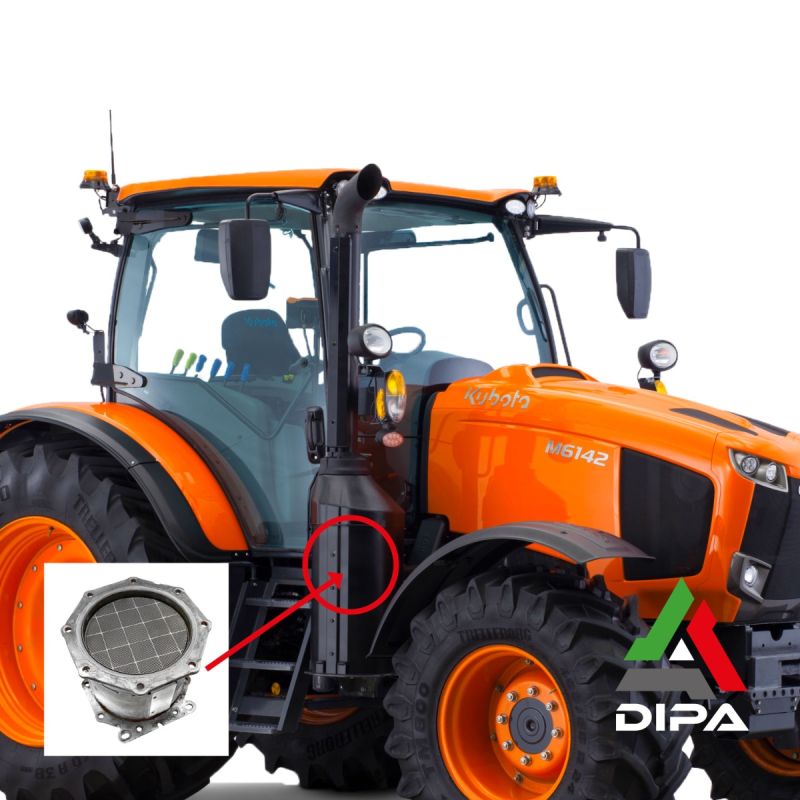


- DiPa Code:
- FAP401R
- OEM Code:
- 1J78318251
- Brand:
- DIPA SPORT
- Cod.Cross:
- Condition:
- Remanufactured
Warnings
WARNING: given the size and weight of this item, the shipping costs will be 15€ for the outbound and 15€ for the return even if your company has a flat subscription for shipping.
Furthermore, IT IS ADVISED that the MAXIMUM length of the FAP/DPF must be 120cm, in case it is longer, cut the part at the "Cutting Points" provided.
For any FAP/DPF longer than 120cm, extra shipping charges will be applied for both pickup (if done by DIPA) and return.
Finally, to avoid breakages and losses of: temperature probes, lambda probes, various sensors, flanges/brackets, and all components mounted on the FAP/DPF, it is necessary to send the piece without such components; otherwise, we will NOT be able to disassemble them in any way and therefore we will NOT be able to revise the FAP/DPF and will be forced to return the piece UNREVISED.
Typical Errors and Defects
Typical defects:
Soot clogging due to light duty cycles or interrupted regenerations
Reduced engine performance
Warning light on the dashboard
Applications
ASHOK LEYLAND
ASHOK LEYLAND DOST
| Model | Year of Production | Displacement | KW | HP | Cylinders | Fuel Type | Engine Code |
|---|---|---|---|---|---|---|---|
| DOST | 2011-02-01 - 2012-12-01 | 1478 cc | 41 KW | 56 HP | 3 Cylinders | Diesel | BS3 |
| DOST | 2011-02-01 - 2012-12-01 | 1478 cc | 41 KW | 56 HP | 3 Cylinders | Diesel | BS4 |
KUBOTA
KUBOTA A
| Model | Year of Production | Displacement | KW | HP | Cylinders | Fuel Type | Engine Code |
|---|---|---|---|---|---|---|---|
| A | 2013-10-01 - | 1001 cc | 15 KW | 21 HP | Cylinders | ||
| A | 2017-01-01 - | 1001 cc | 15 KW | 21 HP | Cylinders |
KUBOTA B
| Model | Year of Production | Displacement | KW | HP | Cylinders | Fuel Type | Engine Code |
|---|---|---|---|---|---|---|---|
| B | 2008-10-01 - | 1123 cc | 18 KW | 24 HP | Cylinders | ||
| B | 2013-01-01 - | 1123 cc | 18 KW | 24 HP | Cylinders | ||
| B | 2017-01-01 - | 1261 cc | 20 KW | 27 HP | Cylinders | ||
| B | 2017-01-01 - | 1123 cc | 18 KW | 24 HP | Cylinders |
KUBOTA L
| Model | Year of Production | Displacement | KW | HP | Cylinders | Fuel Type | Engine Code |
|---|---|---|---|---|---|---|---|
| L | 2009-10-01 - | 1647 cc | 26 KW | 35 HP | Cylinders | ||
| L | 2010-01-01 - | 2197 cc | 33 KW | 45 HP | Cylinders |
KUBOTA MU
| Model | Year of Production | Displacement | KW | HP | Cylinders | Fuel Type | Engine Code |
|---|---|---|---|---|---|---|---|
| MU | 2015-05-01 - | 2434 cc | 40 KW | 55 HP | Cylinders | ||
| MU | 2017-01-01 - | 2434 cc | 40 KW | 55 HP | Cylinders | ||
| MU | 2017-01-01 - | 2434 cc | 33 KW | 45 HP | Cylinders |
KUBOTA Series-M
| Model | Year of Production | Displacement | KW | HP | Cylinders | Fuel Type | Engine Code |
|---|---|---|---|---|---|---|---|
| Series-M | 2012-01-01 - | 3769 cc | 73 KW | 99 HP | Cylinders | ||
| Series-M | 2012-01-01 - | 3769 cc | 65 KW | 88 HP | Cylinders | ||
| Series-M | 2012-01-01 - | 3331 cc | 54 KW | 73 HP | Cylinders | ||
| Series-M | 2012-01-01 - | 3331 cc | 48 KW | 66 HP | Cylinders |
RENAULT, RENAULT KOREA
RENAULT, RENAULT KOREA MASTER III Furgone (FV)
| Model | Year of Production | Displacement | KW | HP | Cylinders | Fuel Type | Engine Code |
|---|---|---|---|---|---|---|---|
| MASTER III Furgone (FV) | 2010-02-01 - | 2298 cc | 74 KW | 101 HP | 4 Cylinders | Diesel | M9T 890 |
| MASTER III Furgone (FV) | 2010-02-01 - | 2298 cc | 74 KW | 101 HP | 4 Cylinders | Diesel | M9T 690 |
Techinical Info
The OE code Kubota 1J78318251 identifies the diesel particulate filter (DPF) used in the exhaust gas post-treatment system on applications with Kubota engines. It is a component intended for diesel engines in construction, agricultural and industrial machinery, commonly associated with the Kubota V3307-CR-T engine, a 4-cylinder turbocharged common rail diesel of approximately 3,331 cc. The filter is an integral part of the particulate reduction system for the off-road emission configurations of this engine family.
Technical specifications
- Component type: diesel particulate filter (DPF)
- Configuration: DOC (catalyst) + DPF
- Associated engine: Kubota V3307-CR-T
- Associated engine displacement: 3,331 cc
- Engine architecture: 4-cylinder turbocharged common rail diesel
- Typical use: post-treatment systems for construction, agricultural and industrial machines
- Operation based on accumulation of particulate and subsequent thermal regeneration of the filter
DIPA can intervene to overhaul these components thanks to its experience and expertise.
Functions
- Traps solid particulate present in the engine exhaust gases
- Works together with the upstream DOC to promote oxidation of unburnt compounds and to manage system temperatures
- Enables reduction of solid emissions required to meet off-road emission standards for these machines
- Operates via controlled regeneration cycles, depending on temperature, engine load and exhaust backpressure
- Requires correct operation of the engine management system, temperature sensors and the differential pressure sensor
- Contributes to engine protection and maintaining emission compliance when the regeneration system functions regularly
Model applications
- KUBOTA M Series
Typical faults
- Soot clogging due to light duty cycles or interrupted regenerations
- Reduced engine performance
- Warning light on the instrument panel
Final conclusions
The Kubota OE 1J78318251 is a DPF intended for the exhaust post-treatment system on Kubota engines.
DIPA can work on this component with a thorough and deep cleaning. Cheaper solutions that add cleaning additives without removing the component (or with only partial disassembly) do not solve the root cause and often prove to be a waste of time and money. Frequently forced regenerations initiated via diagnostic tools are also ineffective. At DIPA we have developed a procedure comprising several intervention phases. The particulate filters undergo a series of decarbonization and purge cycles to remove deposited particles. The result of the process is verified by a series of checks to confirm restored efficiency.
Want to see how we do it? Spend a few minutes watching our video:
DPF Regeneration - How to regenerate the diesel particulate filter | Dipa Method - DIPA Sport